
 EN
 ZH
 JA


 Home
/
News
/
Industry News
/

2026 Guide to Selecting Enterprise-Grade LED Strips: SMD vs. COB Comparison and Practical Tips to Avoid Project Pitfalls (In-depth Analysis by a 20-Year Manufacturer)
How to choose LED strips that actually last is a question most buyers get wrong. As a manufacturer with 20 years in the LED strip business, I’ve watched contractors and procurement officers treat strips as a commodity—”just find them online for a few yuan per meter, as long as they light up.” In reality, flexible LED strips are among the most failure-prone parts of any lighting project, especially in offices, hotels, and showrooms. Six months after install, we see dimming, dark spots, color shift, and uneven light. This guide skips the dry specs and walks you through choosing reliable strips that won’t generate customer complaints.
Today, I’m skipping the dry, technical specifications of LED strips. Instead, I’ll walk you through—in simple, easy-to-understand terms—how to select reliable, high-quality LED strips that won’t lead to customer complaints.
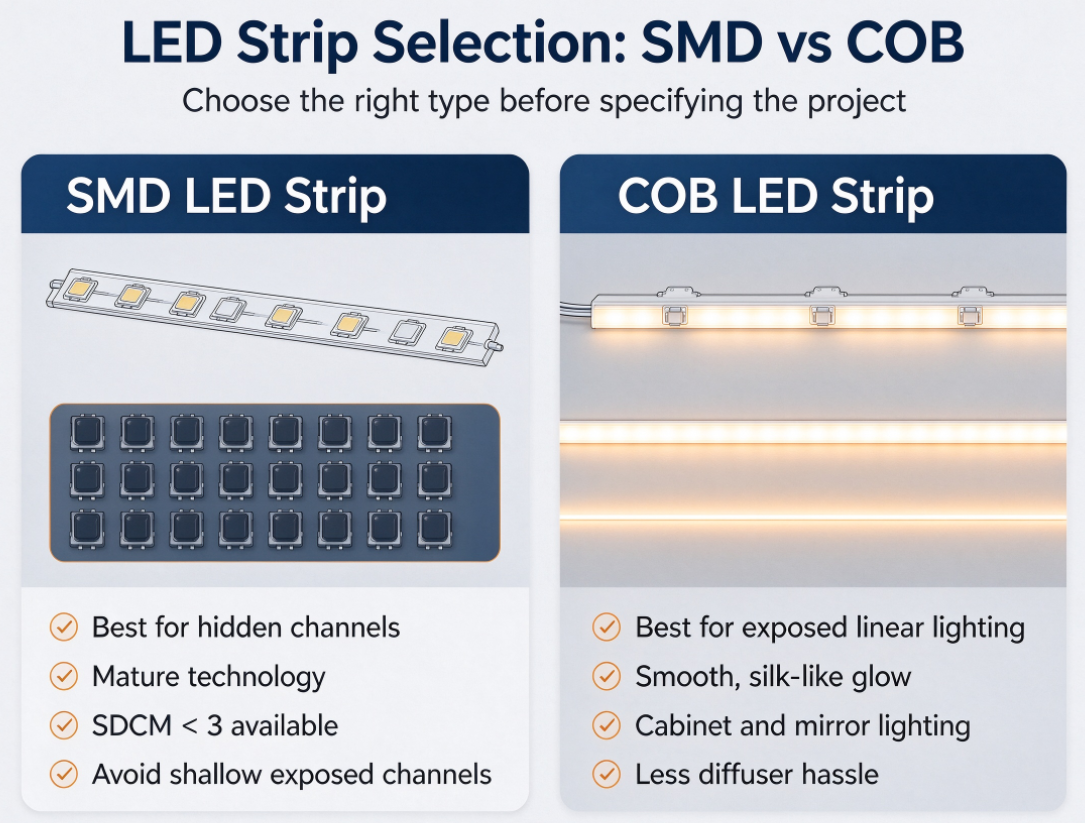
I. What are the common SMD and COB LED strips on the market, and what are their respective advantages?
In the past, when working with linear LED strips, we often encountered a frustrating issue known as the “starry sky” effect: even when SMD strips were covered with a PU diffuser, individual LED beads remained visible from a distance, preventing the light from distributing evenly.
1. SMD (Traditional Surface-Mounted Device strips):
These are suitable for installation in deep light channels or for use as hidden ambient lighting where the strip itself isn’t directly visible. Their advantages include low cost and mature technology. Furthermore, their color consistency is superior to that of COB strips; most can maintain a color tolerance of SDCM < 3 (or even lower), ensuring no color variation within the same batch—a standard that is difficult for COB strips to meet (they often struggle to stay within SDCM < 5). However, SMD strips will fail miserably if installed in shallow channels (less than 5 cm deep) or used to backlight highly reflective materials like stainless steel or marble; the result is a fragmented, patchy light pattern rather than a smooth, uniform glow.
2. COB (Chip-on-Board) LED strips:
These have become a “lifesaver” for lighting projects in recent years, offering easy installation and uniform light output. Because the chips are directly encapsulated on the board, the light emitted is as smooth and even as silk.
Pro tip: If your project involves cabinet lighting, vanity mirror lights, or exposed linear lighting, COB strips are a no-brainer. Spending a little extra upfront saves you the hassle and cost of retrofitting light shields or diffusers later on.
II. Key LED strip specifications for seamless communication between purchasers and manufacturers—confirming these details prevents 99% of potential post-installation issues!
When sourcing, don’t just ask “How much per meter?” Ask the following three questions instead; the salesperson will immediately recognize you as an expert:
1. Color Rendering Index (CRI):
This determines whether your space feels “high-end” or “cheap,” influencing how natural objects appear in reality.
Many cheap LED strips have a CRI of only around 70; they make walls look dull and grayish, and give people’s faces a greenish cast.
This is similar to the lighting used in wet markets for pork and vegetables—very low-CRI light that makes produce look fresh but unrealistic. That is the nature of low CRI.
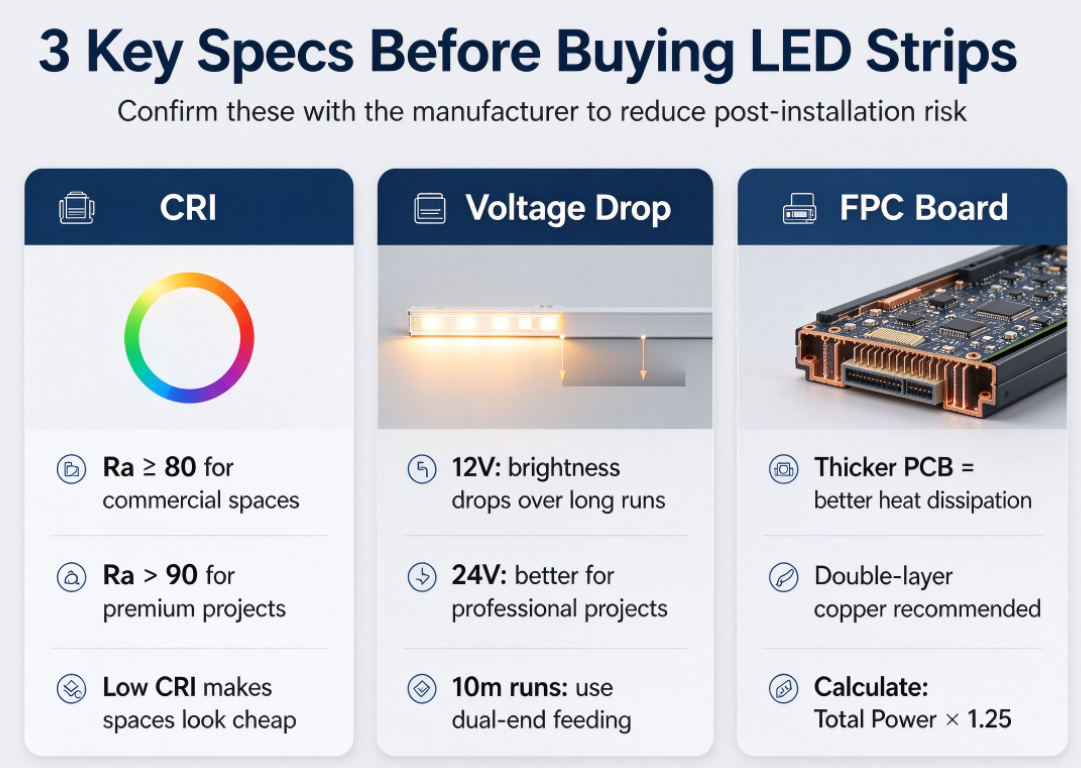
The Benchmark: Commercial office spaces require a minimum CRI (Ra) of 80. However, as renovation standards and expectations for lighting quality rise, most projects now mandate Ra > 90. A higher CRI means objects look more true-to-life—though, naturally, the price will be higher, so keep that in mind!
2. The Voltage Drop Issue—Why does your LED strip start bright but end dim?
You may have noticed this phenomenon with cheap LED strips: the beginning is bright, but the last few meters are noticeably dimmer. This is caused by voltage drop.
Tips to Avoid Pitfalls: Standard 12V LED strips struggle to maintain consistent brightness when powered from only one end over a 5-meter run. For professional-grade projects, I recommend using a 24V power supply system throughout. If a single run reaches 10 meters, you must use “dual-end power feeding.” For even longer runs, opt for strips with built-in constant-current ICs or switch to high-voltage LED strips; otherwise, the brightness discrepancy will cause major headaches during inspection and could even necessitate costly rework.
3. FPC Board Thickness—A key factor in the LED strip’s lifespan
When an LED strip fails, the issue isn’t always the LED chips themselves; often, the circuit traces on the strip’s PCB (Flexible Printed Circuit) have burned out.
Why? Low-quality strips often use extremely thin PCBs. The thinner the PCB, the poorer the heat dissipation; prolonged operation at high power can easily burn out the circuits. To select the right power supply (transformer), calculate the necessary capacity using this formula: Total Power = Strip Power Rating × Length × 1.25 (safety margin/redundancy factor).
Pro Tip: Try bending it with your hands. High-quality strips use double-layer copper—specifically standard 2oz (70μm) copper—making them sturdy and flexible. Circuit boards that feel paper-thin may not even use copper; to cut costs, manufacturers sometimes use iron! Heat dissipation will inevitably be poor, and such strips are guaranteed to fail within six months.
III. Practical Case Study: What parameters matter when installing LED light strips throughout a shopping mall?
In the first half of this year, we handled a lighting project for a company contracted to install commercial lighting—specifically LED strips—across an entire supermarket in the US market. The scope included the installation of power supplies and LED strips (along with other commercial fixtures) for all shelving, refrigerated cabinets, wall-mounted guide lines, and pendant lights. Here is how we approached the specific requirements regarding the LED strips:
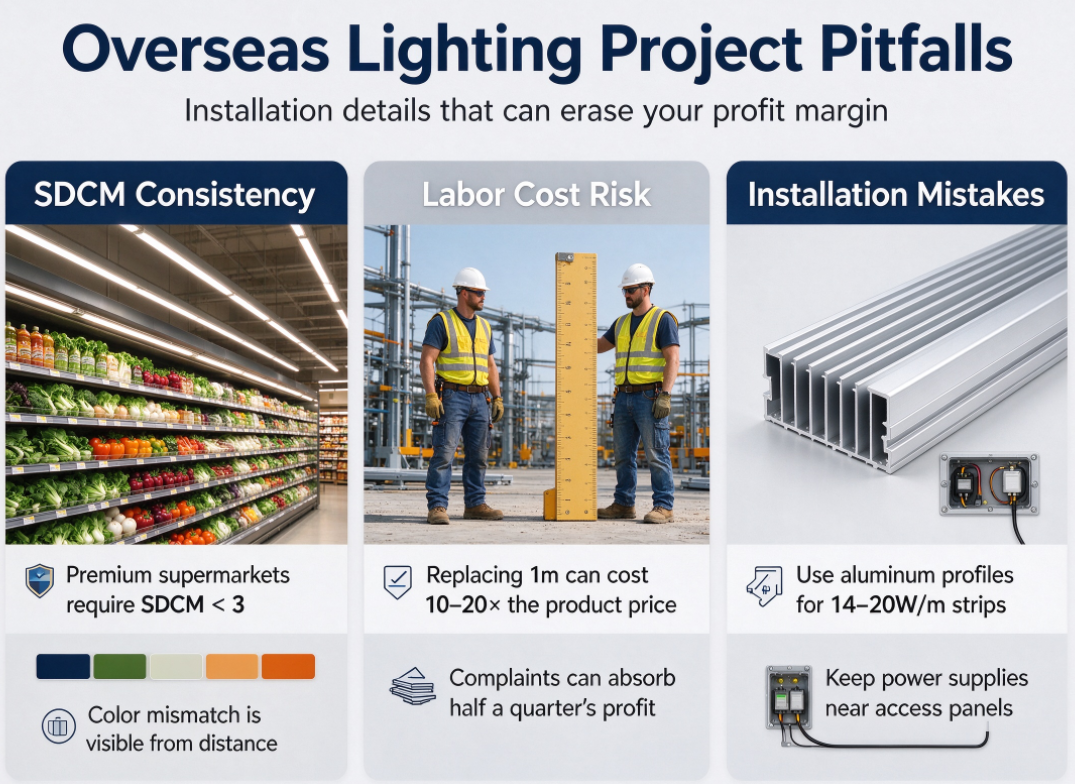
Pay attention to SDCM (Standard Deviation of Color Matching): High-end supermarkets prioritize light quality—specifically, the consistency of the light output. Requirements typically specify an SDCM of less than 3. In public spaces like supermarkets, any inconsistency in light color is immediately noticeable from a distance, making this factor crucial.
LED strip quality: Since this project was for an overseas market, uncompromising quality was essential. If customer complaints later necessitated replacing the strips, the resulting labor costs would far exceed the profit margin of the strips themselves—effectively turning the project into a financial loss.
Luminous efficacy: The lighting had to meet specific efficacy standards. Supermarkets operate under strict lighting specifications; lighting that is too dim is unacceptable—especially in international markets—so the luminous efficacy had to meet the required benchmarks.
IV. Pitfall Avoidance: Details Often Overlooked During Installation
To save time and effort, many installation crews resort to rough workmanship and frequently make the following two mistakes:
1. Failing to use aluminum profiles for heat dissipation:
As previously mentioned, the LED strip’s own circuit board provides some heat dissipation; however, for high-wattage projects, this is insufficient. Thermally conductive metal profiles—specifically aluminum—are required to assist with heat dissipation. Many people mistakenly adhere high-wattage LED strips directly onto wood or drywall. Remember: for LED strips with a power rating of 14–20W/m, the use of aluminum heat-dissipation channels is mandatory. Otherwise, the rapid lumen depreciation will be shocking, and the strips will become dangerously hot to the touch after prolonged use.
2. Power supply hidden too deeply:
Power supplies (transformers) have a limited lifespan; furthermore, cheap units are particularly prone to failure or making abnormal noises. Never let workers seal the power supply inside a suspended ceiling or wall; it must be positioned near an access panel. Otherwise, if it fails later, you would have to dismantle the ceiling or tear down a large section of the wall—or else simply stare helplessly at a strip of lights that won’t turn on.
When preparing for overseas lighting projects scheduled for 2026, project stakeholders often focus solely on brightness while overlooking the energy efficiency thresholds set by the latest ErP standards. Achieving a high luminous efficacy of 200 lm/W has effectively become an implicit requirement for securing project insurance coverage in Europe and the US. Drawing on 20 years of manufacturing experience, we have found that obtaining comprehensive UL/CE certifications is not merely a regulatory formality but a crucial step in mitigating legal risks for projects. We welcome inquiries and discussions regarding these new energy efficiency standards.
We are Shenzhen Mingxue Optoelectronics Co., Ltd. We operate a 24,000-square-meter production facility that guarantees product quality and timely delivery, supported by an R&D team of over 20 specialists dedicated to solving client challenges. With a strong, long-standing presence in European and US markets, we hold international certifications such as UL, CE, SAA, and RoHS. These certifications serve not only to facilitate customs clearance but also to meet the underwriting requirements for overseas project insurance, thereby reducing legal risks for project stakeholders. Our export-grade LED strips fully comply with the upcoming 2026 ErP (European energy efficiency) regulations; thanks to our R&D team’s efforts, we have achieved luminous efficacy levels of 200 lm/W or higher. We have specialized in LED strip manufacturing for two decades, focusing on providing LED lighting solutions for mid-to-high-end enterprise clients.
Published by Mingxue Lighting | Founded 2005 | Shenzhen R&D Center + Foshan Manufacturing Base | 24,000 sqm | ISO 9001 Certified


