
 EN
 ZH
 JA


 Home
/
News
/
Industry News
/

Low Voltage vs High Voltage LED Strips: Which Is More Energy-Efficient?
When purchasing LED strips for restaurants or commercial spaces, most buyers fixate on brightness and price while overlooking the one factor that hits the bottom line daily: power consumption. The choice between low voltage vs high voltage LED strips directly shapes your electricity bill, whether you run a shopping mall or a small eatery. Here, Mingxue Lighting—a manufacturer with 24,000 m² of facilities and 21 years in the industry—breaks down how each type performs on energy efficiency and long-term cost, so you can pick the right strip without guessing.
1. Basic differences between low-voltage and high-voltage LED strips
① Low-voltage LED strips
Available in various voltages such as 5V, 12V, and 24V, these are widely used for indoor lighting and short-range outdoor lighting projects.
Advantages: Small cutting increments, minimal power loss, easy installation and connection, and safe to use due to low voltage.
Disadvantages: High current flow; prone to voltage drop in long-distance outdoor applications; excessive power can lead to heat dissipation issues.
② High-voltage LED strips
These operate directly on 110V or 220V mains power without requiring an external transformer and are extensively used in outdoor lighting projects.
Advantages: Lower current; a single strip can extend up to 100 meters in a series connection; requires less complex wiring.
Disadvantages: Waterproofing is critical for outdoor use; generally considered unsafe and prohibited for indoor use; typically characterized by high power consumption.
2. Comparison of Power Consumption Formulas
The fundamental difference in energy consumption lies in the luminous efficacy (lm/W) of the LED chips, not the operating voltage. The PRO series of LED strips from Mingxue Optoelectronics utilizes large-sized, dual-chip technology, achieving a luminous efficacy of 205–227 lm/W. This meets the EU’s ErP Class B standard and allows for a 30%–40% reduction in power requirements for the same level of brightness. In contrast, traditional high-voltage LED strips—constrained by chip specifications and heat dissipation limitations—typically offer a luminous efficacy in the 100–150 lm/W range.
For a 5-meter LED strip requiring the same brightness (1000 lumens):
• Low-voltage LED strip (205 lm/W efficacy): ~4.9W (LED power consumption) + 0.5W (driver loss) = 5.4W total power consumption.
• High-voltage LED strip (120 lm/W efficacy): ~8.3W (LED power consumption) + 0.6W (rectifier loss) = 8.9W total power consumption.
Under identical conditions, high-voltage LED strips generally consume more electricity due to their higher power requirements.
3. Factors Affecting LED Strip Power Consumption
① Voltage drop along the circuit: In low-voltage systems, long-run lighting setups experience significant power loss, which drives up total energy consumption.
② PCB substrate material: Strips with thin copper layers have poor electrical conductivity, leading to increased heat generation—which wastes additional energy and accelerates lumen depreciation (light decay).
③ Power conversion loss: Low-voltage LED drivers typically incur a 5%–8% energy loss; high-voltage strips, by eliminating the need for a transformer/driver, avoid this conversion loss.
④ Usage scenario: In applications such as long-term outdoor lighting or commercial lighting for 24-hour establishments, the disparity in energy loss becomes even more pronounced over time.
4. Recommendations from Mingxue Optoelectronics
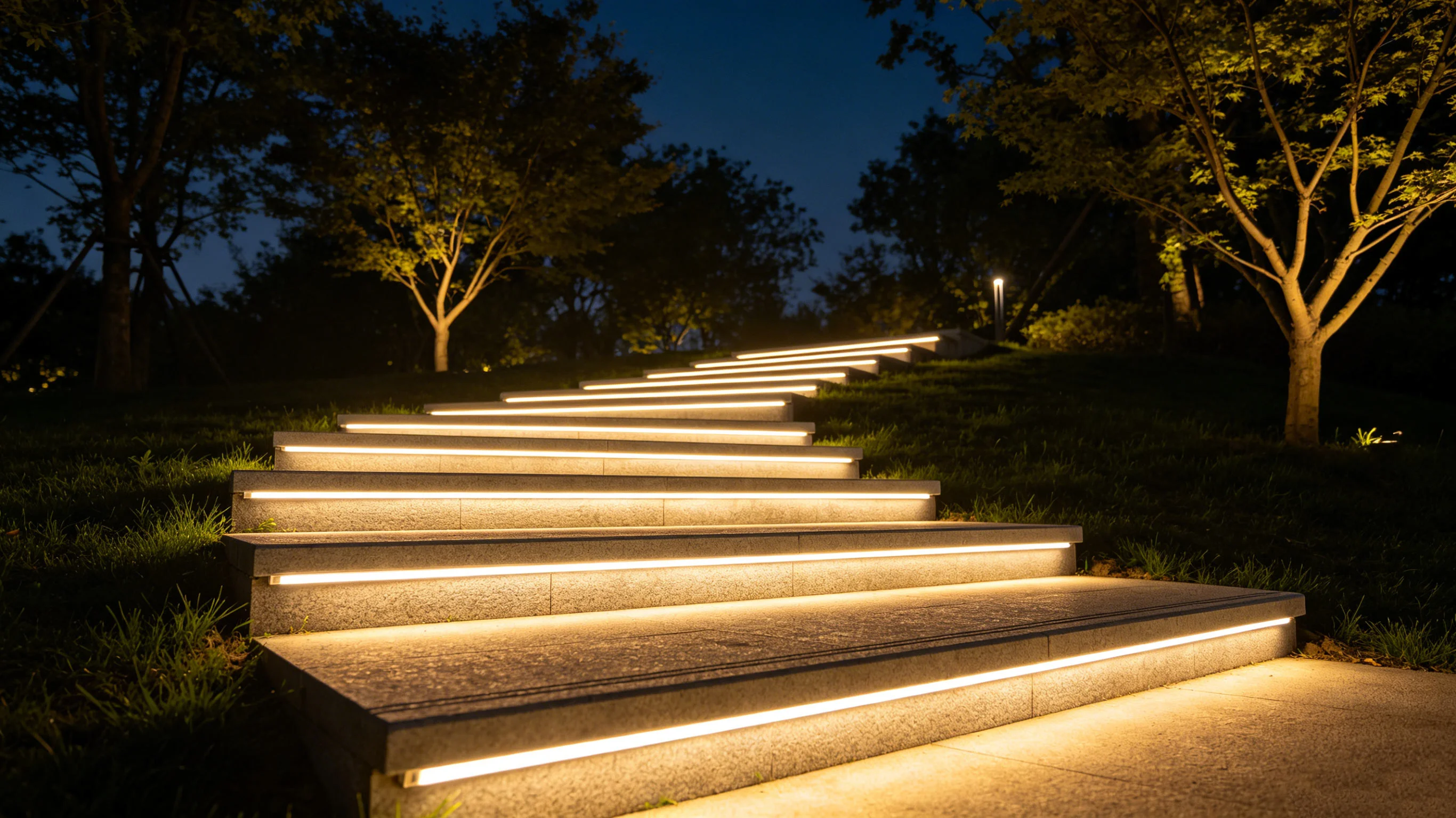
① For indoor localized lighting (within 5 meters), automotive ambient lighting, or small display cabinet lighting: Use 12V/24V low-voltage LED strips for enhanced safety.
② For building facades, large-scale municipal landscape lighting, or long-distance storefront contour lighting: Prioritize 220V high-voltage LED strips to reduce line loss and save on long-term electricity costs.
③ For long-run, low-voltage lighting installations: Select LED strips built on 2oz rolled-copper PCBs, and ensure a 20% power capacity margin for the power supply.
④ For outdoor lighting: Use high-voltage LED strips with an IP67 (or higher) ingress protection rating to minimize failures and maintenance costs.
| Comparison Dimension | Low-Voltage LED Strips | High-Voltage LED Strips | Selection Recommendation |
|---|---|---|---|
| Parameters & Power Consumption | Mainly 12V/24V, requires matching power driver; large operating current. Long-distance line loss of 10%-20%, with extra power consumption. | 220V direct drive, no transformer required; extremely low operating current. Long-distance line loss less than 3%, more energy-saving for long-term use in large projects. | Power consumption stays the same at equal wattage. Prioritize high-voltage strips for lighting projects over 5 meters, to greatly reduce long-term electricity operating costs. |
| Project Adaptability | Fine cutting units, suitable for short-distance irregular shapes; prone to voltage drop over long runs, multi-point power supply required, high wiring & labor costs. | Up to 100m series connection with no obvious voltage drop, no extra drivers needed. Wiring work is drastically reduced, lower overall construction & material costs. | Choose low-voltage strips for detailed shaping within 5m and partial indoor lighting. Prefer high-voltage strips for building facades, municipal landscapes and other long-distance large-scale projects. |
| Safety Compliance & Application Scenarios | Within safe voltage range, extremely low electric shock risk, usable indoors and outdoors. Fits home no-main-light design, commercial lighting, vehicle ambient lighting, etc. | Falls under high-voltage electrical category, restricted for indoor use. High-grade waterproof protection mandatory for outdoor applications; ideal for large outdoor outline and bridge lighting. | High-voltage strips are strictly prohibited for indoor use. Outdoor high-voltage projects must adopt engineering-grade strips with IP67 or higher waterproof rating and compliant certifications. |
5. Summary
Mingxue Optoelectronics has specialized in LED linear strip lighting for 21 years. Operating from a 24,000 m² production facility, the company mass-produces a comprehensive range of low-voltage and high-voltage architectural strips suitable for residential “trimless” (ceiling-light-free) designs, commercial lighting, outdoor landscape illumination, export markets, and cross-border projects. Its entire product line holds international certifications such as UL, CE, and SAA, and supports custom specifications for RGB, dual-color temperature, high-voltage, wall-washer, and silicone-encapsulated waterproof strips. The company provides one-stop technical support—including voltage drop simulation, energy consumption analysis, and lighting scheme design—to lighting designers and contractors, while strictly controlling PCB copper thickness and encapsulation processes to minimize circuit loss and light decay. As a direct manufacturer, Mingxue balances procurement costs with long-term energy efficiency, ensuring the successful and stable implementation of diverse lighting projects.
In summary:
Low-voltage strips are better suited for residential interiors and short-range outdoor lighting.
High-voltage strips are better suited for large-scale outdoor lighting projects, such as bridge illumination and architectural facade accent lighting.
Published by Mingxue Lighting | Founded 2005 | Shenzhen R&D Center + Foshan Manufacturing Base | 24,000 sqm | ISO 9001 Certified


