
 JA
 EN
 ZH


LED Strip Aluminum Profile: Why It’s Essential for Linear Light
LED strip aluminum profile pairing isn’t a cosmetic afterthought—it’s a precision decision about optics, thermal management, and product longevity. Seasoned lighting engineers insist on mounting LED strips in aluminum channels for both interior accent and exterior scene lighting, yet many assume the choice is purely aesthetic. From 21 years as an architectural LED strip manufacturer, we break down why the aluminum profile is the indispensable “perfect partner” for linear and trimless lighting systems—and what goes wrong when you skip it.
I. The Underlying Logic of Uniformity: The “Leverage Effect” of Depth and Density
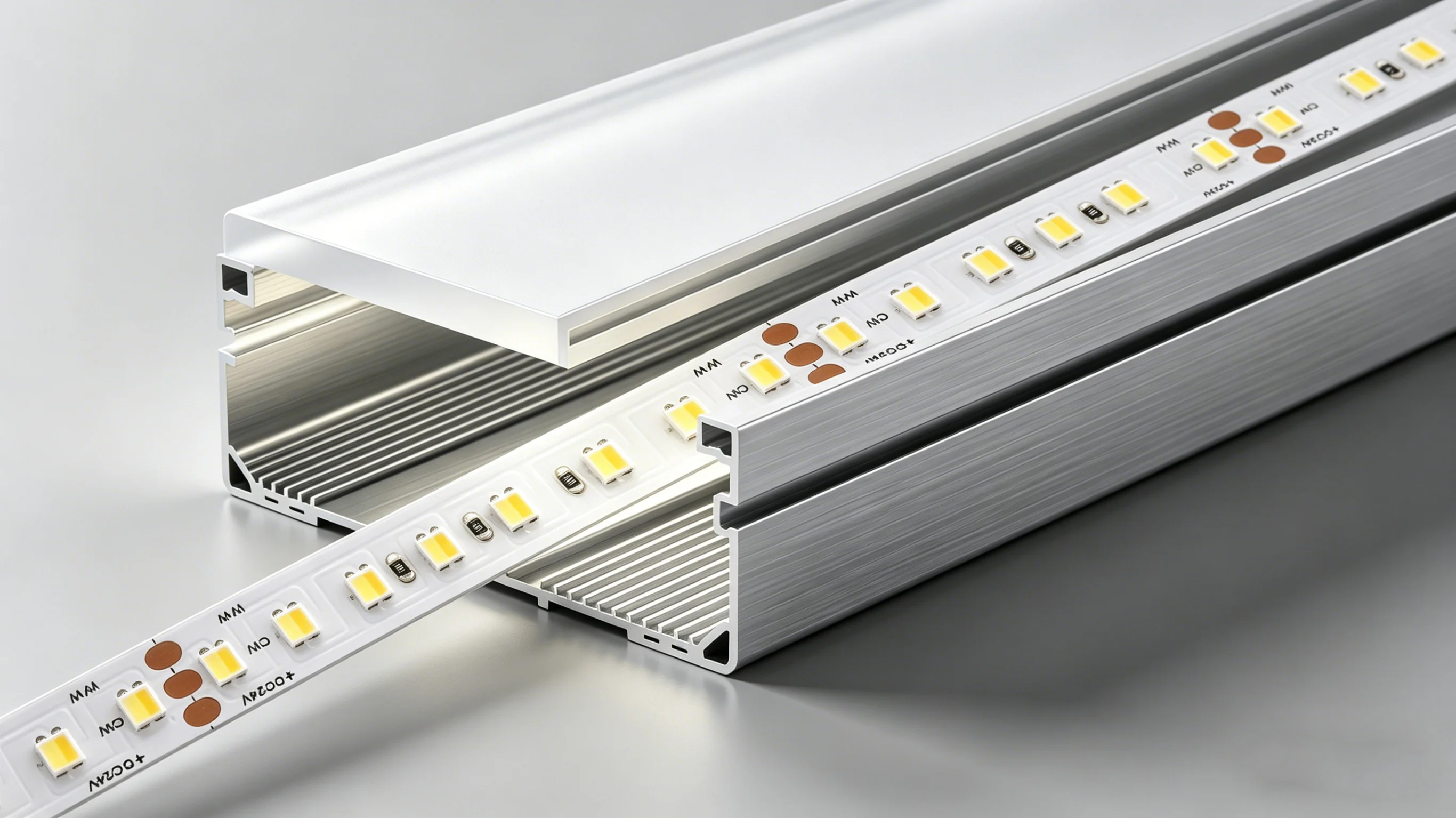
Standard SMD and COB LED strips can achieve a premium linear lighting effect—where the light source itself is invisible, revealing only the illumination—when installed in aluminum channels.
1.1 Physical Principles and Diffusion Angle:
Standard LED chips typically have a beam angle of 120°. As light emits from the source, it requires space to diffuse and overlap; this is precisely why the depth of the aluminum channel is critical to the resulting lighting effect.
1.2 The Interplay Between Depth (H) and Pitch (P):
1.2.1 Shallow Aluminum Channels:
If the channel is too shallow, the light beams from the LEDs lack sufficient distance to diffuse properly. If dark spots appear in the projected light, the LED density must be increased (e.g., to 120 LEDs per meter or more) to fill in these dark areas; otherwise, distinct light dots or jagged light patches will be visible.
1.2.2 Deep Aluminum Channels:
When the aluminum channel provides sufficient depth, the physical distance naturally facilitates light mixing. Even with a lower LED density, it is possible to achieve uniform, soft linear lighting.
Uniformity is not determined by a single parameter but rather by the interplay between the light-mixing space (depth) and the spacing between light sources (LED density); this serves as the basis for selecting the right aluminum channel for “ceiling-light-free” (or minimalist) linear lighting designs.
II. Visual Consequences of Poor Component Selection
An incorrect combination not only fails to enhance the aesthetic quality but actually exposes a “cheap” look—a common pitfall in lighting projects involving LED strips:
2.1 Shallow aluminum channel + Low LED density:
This is a frequent error. The light appears harsh and rigid, and glaring “jagged” light spots appear on the diffuser, completely undermining the aesthetic appeal of linear or “no-main-light” (ambient-only) lighting designs.
2.2 Deep channel + High power:
Blindly prioritizing depth while neglecting internal reflection design causes the luminous flux to undergo repeated internal refractions and losses, directly resulting in an output brightness that falls short of design specifications; furthermore, an insufficient number of LEDs leads to issues with light spots and dark zones.c
III. Why stick with the aluminum channel + LED strip combination?
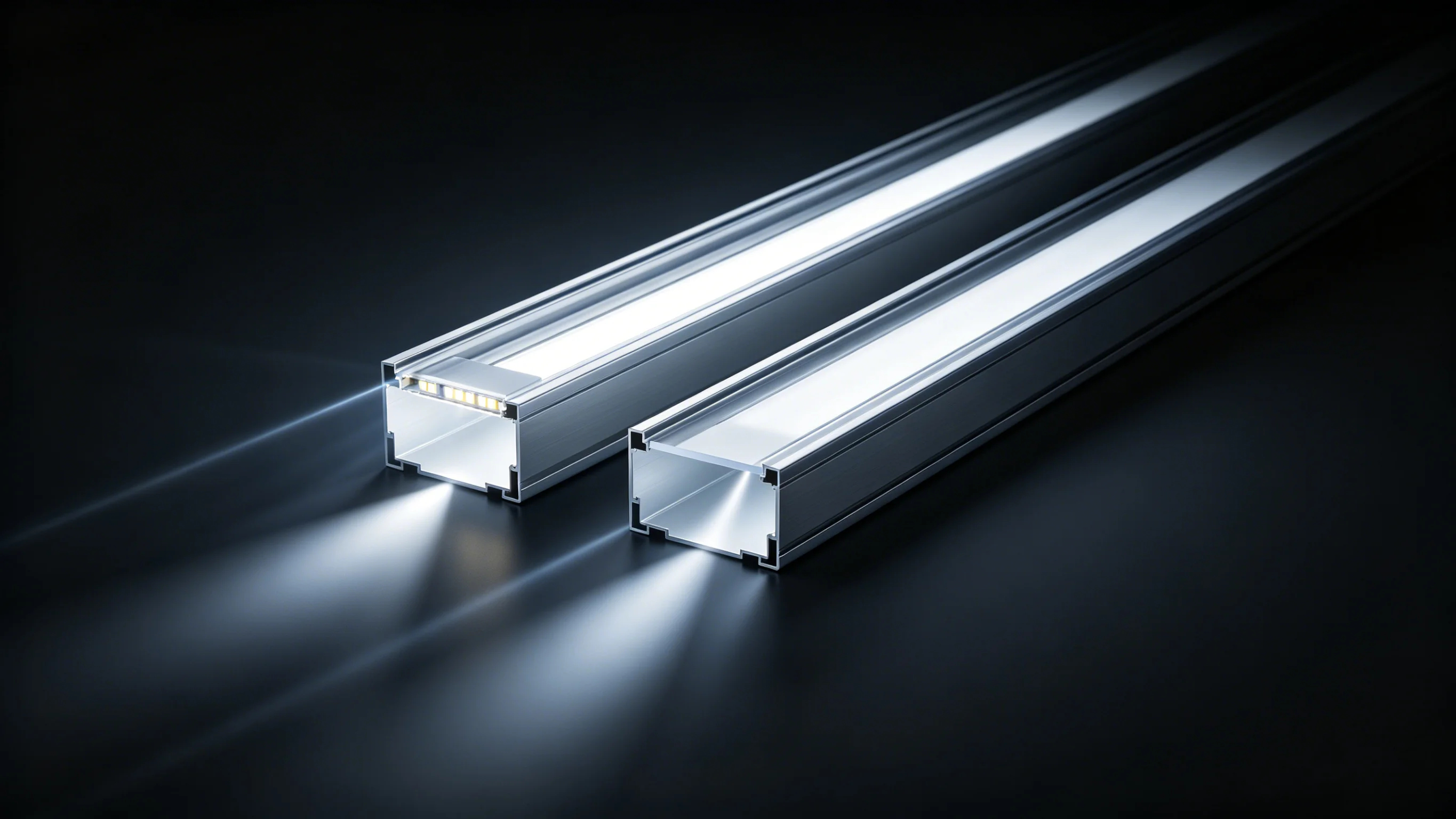
It is often said that aluminum channels and PC covers are used simply to make the light look better. While true, that is not the whole story. Their more critical role is ensuring that LED strips—whether linear, “no-main-light” design, or COB types—can reliably achieve their full 50,000-hour lifespan.
The aluminum channel handles heat dissipation, preventing heat buildup in the LED chips that would otherwise lead to premature lumen depreciation. The PC cover manages light diffusion and physical protection while stabilizing color temperature and consistency. That is why professional-grade, outdoor, COB, and dual-color-temperature LED strips all feature this combination as standard. It is not about over-engineering; it is about ensuring long-term durability and reliable performance in professional lighting applications.
3.1 Thermal Management (Heat Dissipation)
Heat dissipation directly determines the lifespan of LED strips. If you mount LED strips (including linear or COB types) directly onto wood or drywall, heat cannot escape effectively; this leads to lumen depreciation, reduced brightness, and a shortened lifespan. Aluminum channels are excellent thermal conductors; they rapidly dissipate operating heat, preventing degradation caused by high temperatures and fully meeting the 2026 standards for long-life LED strips. Pairing your LED strips with aluminum channels is the ideal solution for managing heat and extending their service life.
3.2 Maintaining Light Quality
If LED strips feel glaring, or if the color and light output appear uneven, the problem is often the lack of a PC diffuser cover. This cover serves two crucial functions:
First, glare prevention. Individual LED chips are point light sources that can be harsh to look at directly. The PC cover transforms this into a surface light source, creating soft, linear illumination that is comfortable and glare-free.
Second, color temperature stability. As light passes through the cover, it remains unaffected by external factors; whether using dual-color temperature strips, COB strips, or professional-grade strips, the light output remains uniform—free from localized color shifts, hotspots, or dark patches. Therefore, this cover should not be underestimated; it plays a crucial role in both visual comfort and color rendering accuracy.
3.3 Environmental Adaptability
Without physical protection, standard LED strips and linear strips are vulnerable to dust, moisture, and mechanical impact, which can lead to malfunctions, short circuits, or dead LEDs. These risks are particularly high in outdoor decorative lighting and professional lighting projects. Installing an aluminum profile creates a robust physical barrier—dustproof, moisture-resistant, and impact-resistant—significantly reducing environmental damage to the strip. For demanding applications such as outdoor decorative lighting, professional lighting projects, IP67 waterproof strips, and outdoor linear lighting, aluminum profiles are not merely optional accessories but standard essentials.
IV. What happens if you use neon LED strips?
Neon LED strips do have a genuine advantage: they are flexible and easy to shape, allowing you to bend them however you like. However, if you are working on professional projects—such as fixed linear lighting, architectural illumination, or “no-main-light” (ceiling-light-free) designs—their shortcomings become apparent. They suffer from poor heat dissipation, heat buildup, rapid lumen depreciation, and a short lifespan; furthermore, their light control and uniformity fall far short of LED strips housed in aluminum channels.
Simply put, flexible neon strips are fine for DIY fun. But for actual architectural lighting, outdoor illumination, or home linear lighting projects, the aluminum channel solution is the way to go. Don’t be misled by their soft, pliable appearance.
4.1 Heat Dissipation Bottleneck:
Silicone encapsulation dissipates heat far less effectively than aluminum. Prolonged high-power operation leads to overheating, rapid lumen depreciation, and a shortened lifespan. If longevity and high brightness are your priorities, choose the aluminum channel solution; don’t sacrifice durability for aesthetics.
4.2 Flexibility:
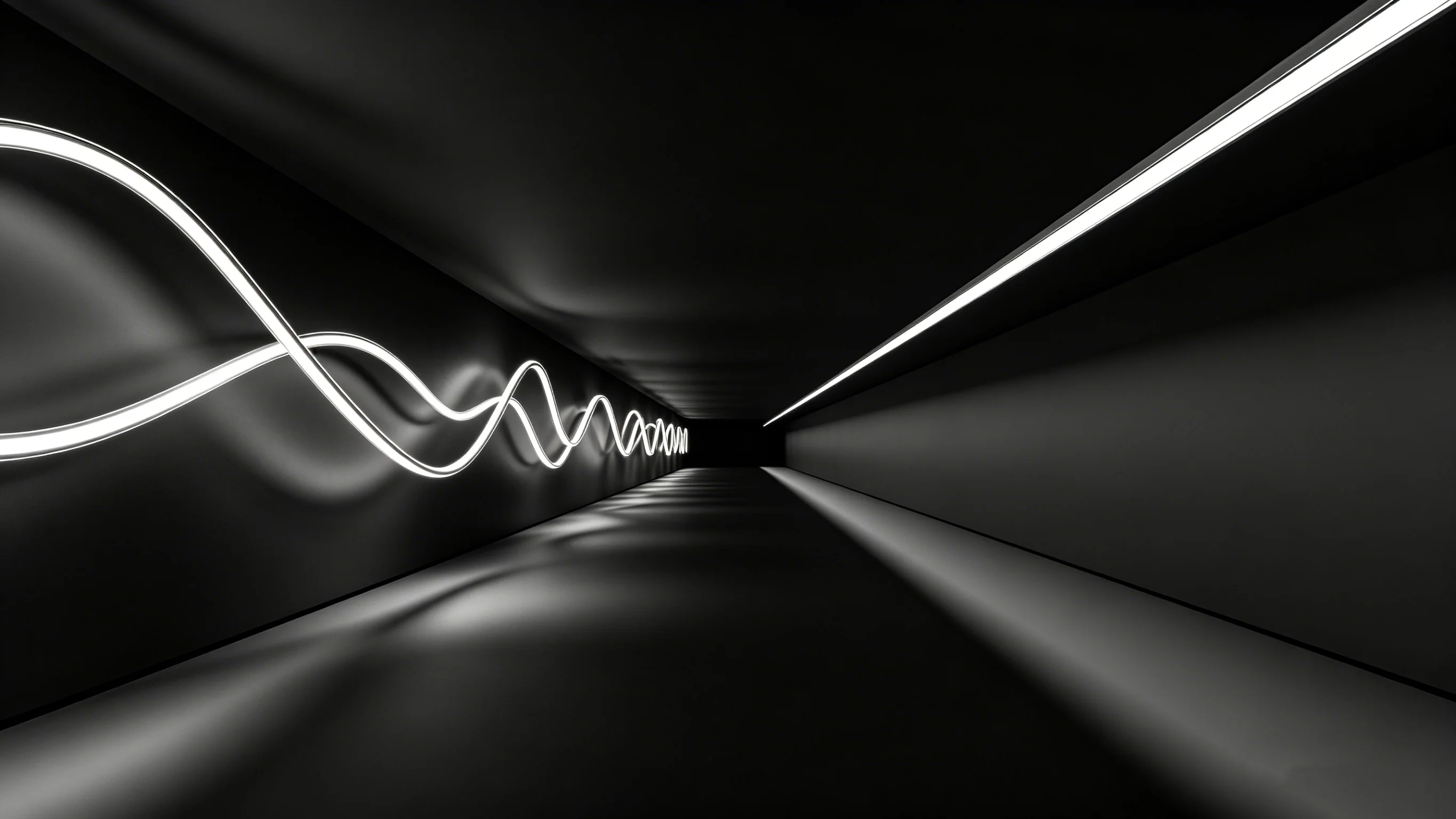
Professionals in architectural and linear lighting know that while neon strips are soft and easy to shape, that flexibility is a double-edged sword. In long-run installations—such as outdoor linear lighting—the finished line often develops a “wavy” look; it appears crooked and uneven, lacking a premium feel whether viewed up close or from a distance.
In contrast, LED strips in aluminum channels offer a straight, crisp, and clean look that maximizes the linear lighting effect. So, if you are aiming for high-quality lighting aesthetics or a seamless linear look without overhead ceiling lights, don’t hesitate—choose the aluminum channel solution. It delivers a truly professional-grade result.
4.3 Luminous Efficacy Loss:
You might assume that the same power input yields the same brightness, but that isn’t the case. With neon or flexible silicone strips, the outer silicone casing absorbs and refracts some of the light—effectively “consuming” a portion of the brightness and resulting in a loss of luminous efficacy. Aluminum-channel LED strips are different. They feature a high-transmittance PC cover that allows light to shine through with almost no loss. For the same power input, these strips deliver higher brightness and more uniform light output. Don’t be misled by wattage ratings; the optical design of a linear light is the key factor determining its performance.
V. Industry Perspective and Professional Validation
Many architectural lighting and “trimless/ceiling-only” (no-main-light) projects fail at the final stage—not because the LED or linear light strips themselves are defective, but because the diffuser covers were poorly matched. We have conducted extensive testing at our 24,000-square-meter production facility and found that light-mixing results vary significantly depending on the batch and material of the PC diffusers. Some provide uniform light transmission, while others suffer from visible LED hotspots, dark zones, dotted light patterns, or even uneven color distribution. Our advice is straightforward: whether you are working on architectural lighting, residential linear lighting, or “no-main-light” designs, you must create and test prototypes using the actual light strips, aluminum profiles, and diffusers before proceeding to mass production. Only move forward with the bulk order once you have confirmed that light uniformity and output quality meet the required standards. Do not cut corners here; the costs saved by avoiding rework through prototyping far exceed your expectations.
5.1 Quality Assurance:
When selecting manufacturers for LED or architectural-grade light strips, do not focus solely on price. Prioritize UL, CE, and SAA certifications, which indicate that materials, circuitry, and high-temperature aging stability have passed rigorous testing—making them ideal for export and large-scale architectural lighting projects.
5.2 Design Recommendations:
Prioritize linear light strips and COB strips that support “cut-at-every-LED” (or single-LED-interval) customization. When installed with aluminum profiles, this allows for precise alignment, preventing dead pixels or dark zones and ensuring a superior final result for “no-main-light” lighting designs.
| Dimension | Key Points | Key Conclusions (Must-read for Designers & Contractors) |
|---|---|---|
| Principle of Light Uniformity | Aluminum channel depth H + LED pitch P = Light mixing effect | Deep channel = natural light mixing, uniform brightness even with low LED density; Shallow channel = requires high-density LEDs, otherwise hotspots appear |
| Consequences of Wrong Selection | Shallow channel + low density / Deep channel + high power | Shallow channel + low density: jagged hotspots, cheap appearance; Deep channel + high power: heavy light loss, insufficient brightness |
| 3 Core Benefits of LED Strip + Aluminum Channel | Heat dissipation, light control, protection | Heat dissipation prevents lumen depreciation & extends lifespan; PC cover reduces glare and stabilizes CCT; Dustproof, moisture-resistant & impact-resistant, standard for engineering projects |
| Neon LED Strip Comparison | Heat dissipation, flatness, luminous efficiency | Neon strip: flexible yet poor heat dissipation, prone to waving, low efficacy; Aluminum channel strip: straight, durable, high brightness |
| Industry Implementation Advice | Sample testing, certifications, cuttable per LED chip | Produce samples before mass order; select UL/CE/SAA certified products; cut per LED chip for higher precision |
A successful architectural lighting or “trimless” (no-main-light) project is never merely a matter of piling up fixtures; rather, it hinges on the precise management of the illuminated space and thermal management solutions. Pairing LED strips with aluminum profiles not only enhances aesthetics but also ensures the reliable performance and longevity of LED strips used in professional linear lighting projects. With 21 years of expertise in the R&D and manufacturing of LED strips—including dual-color temperature, COB, and architectural-grade linear strips—Mingxue Optoelectronics provides comprehensive technical services, ranging from aluminum profile matching and linear lighting solutions to design support for trimless lighting systems.
Published by Mingxue Lighting | Founded 2005 | Shenzhen R&D Center + Foshan Manufacturing Base | 24,000 sqm | ISO 9001 Certified


