
 EN
 ZH
 JA


 Home
/
News
/
Industry News
/

Top-Bend vs Side-Bend Neon Strips: Choose the Right Bend Type for Your Project
Silicone neon strips have become the go-to flexible linear lighting for signage, façades, and artistic installations—but the choice between top-bend vs side-bend neon strips is where most installation failures actually begin. Each strip is structurally engineered to bend in one specific direction; forcing the wrong bend can snap the internal FPC board while leaving the silicone shell looking perfectly intact. In this guide, we break down top-bend, side-bend, and 3D neon strips so you can match the right product to your lighting blueprint and avoid costly rework.
1. What are “top-bend” and “side-bend” neon LED strips?
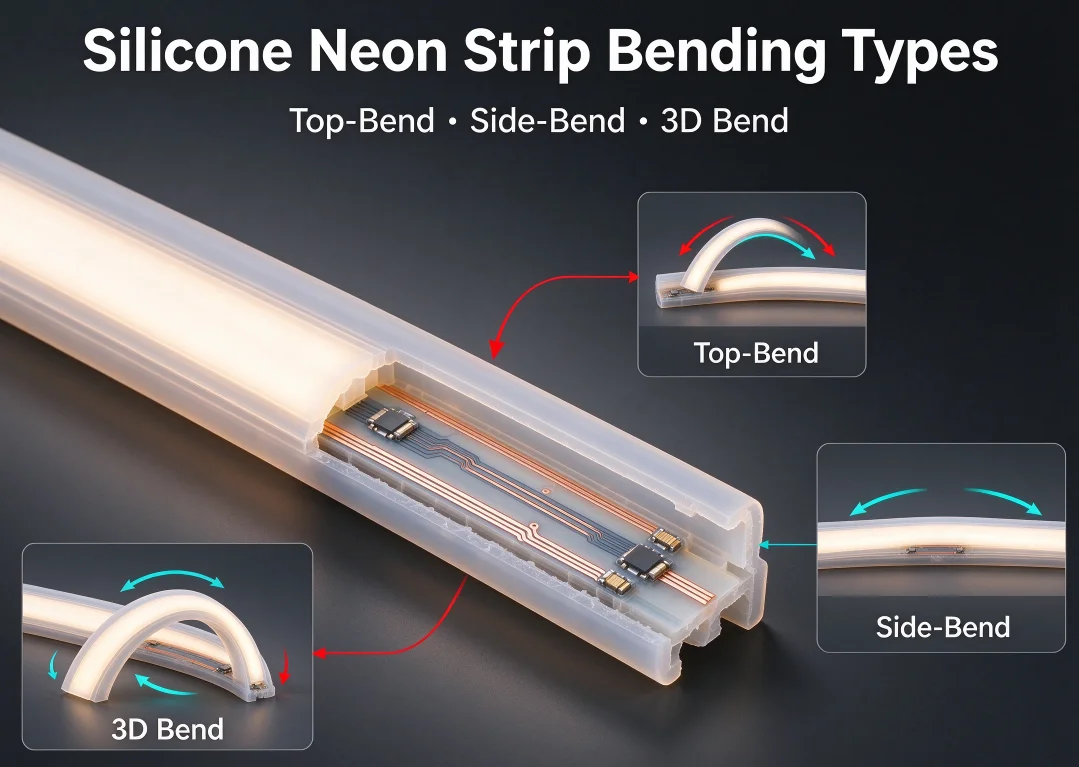
The terms “top-bend” (or “front-bend”) and “side-bend” used for silicone neon LED strips on the market do not refer to the strip’s physical flexibility or softness; rather, they indicate the specific direction in which the strip is structurally designed to bend:
1.1. Top-bend neon LED strips:
These are designed to bend only in an up-and-down motion. They are suitable for ceiling wash lighting, curved vaults, and vertical wave-like lighting designs. Bending them sharply from side to side can snap the internal copper foil circuitry.
1.2. Side-bend neon LED strips:
These support bending only along a horizontal plane (left and right). They are ideal for flat illuminated signage on storefronts, wall outlines, and tracing the contours of circular logos. Bending them vertically (up or down) can easily damage the internal substrate.
1.3. 3D (bi-directional) neon LED strips:
These support bending in both vertical (up/down) and horizontal (left/right) directions. They are suitable for sculptures, irregular curved surfaces, and complex shapes with multiple turns. However, this does not mean they can be twisted arbitrarily or folded at sharp right angles; there are still limits regarding the minimum bending radius.
2. Reverse Bending: Intact Exterior, Internal Damage
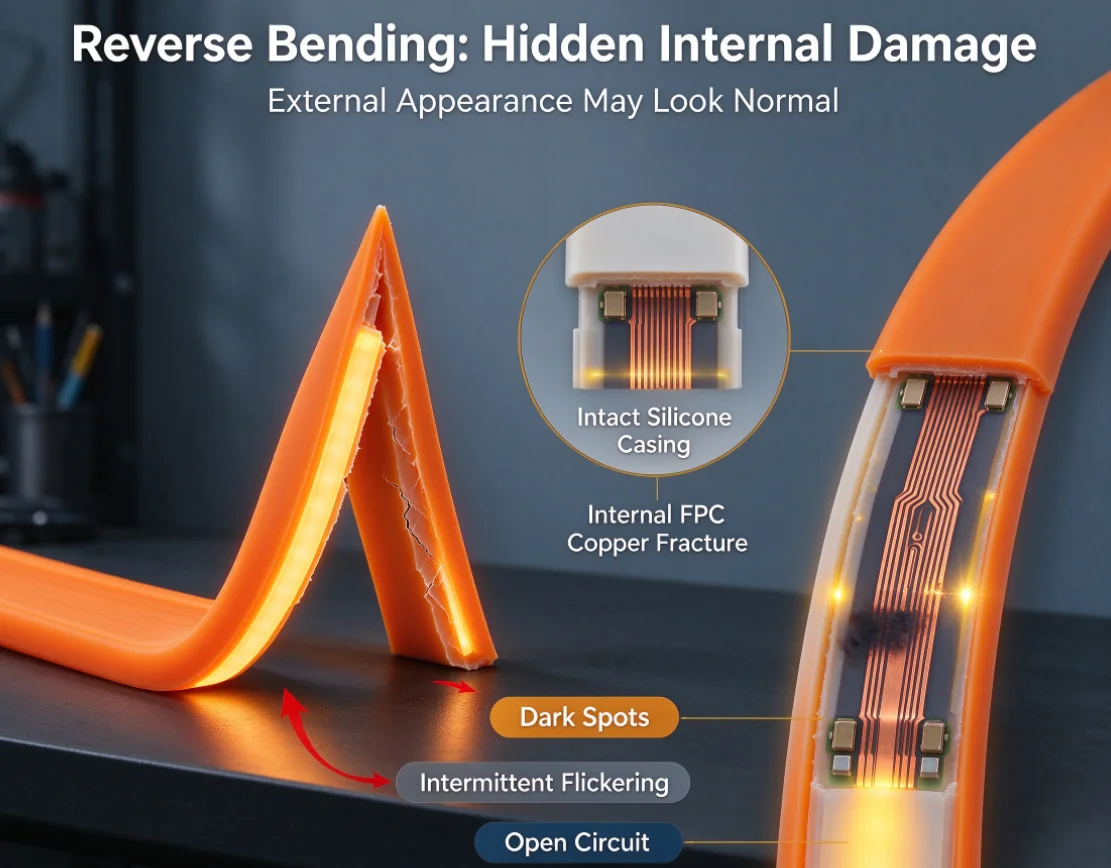
The outer layer of silicone neon lights is made of highly elastic fumed silicone, which withstands minor deformation; even when bent forcefully in the opposite direction, the outer silicone does not crack or break. However, the internal core—comprising the FPC (flexible printed circuit board) and conductive copper foil—snaps due to the tensile stress. Typical symptoms include a strip that appears physically intact but exhibits localized dark spots or intermittent flickering when powered on, eventually leading to a complete open circuit caused by repeated thermal expansion and contraction. Whether dealing with indoor dual-color-temperature neon or IP67 outdoor waterproof neon strips, forcing a bend in a direction contrary to the design specifications will result in hidden internal damage.
3. Installing neon LED strips: Sketch the design first, then select the appropriate strip dimensions.
Before purchasing neon LED strips, you must map out the complete lighting path and mark all turning angles and bending directions:
3.1. For vertical undulations (up-and-down waves) only → Choose “top-bend” (vertical-bend) neon LED strips;
3.2. For flat, horizontal curves or corners only (e.g., illuminated lettering or 2D outlines) → Choose “side-bend” (horizontal-bend) neon LED strips;
3.3. For complex, multi-dimensional curved shapes involving both vertical and horizontal bends → Choose 3D (bi-directional) bendable neon LED strips.
4. Comparison Table
| Strip Type | Bendable Direction | Applicable Scenarios | Prohibited Operations |
|---|---|---|---|
| Forward Bend Neon | Bend only up and down | Arched ceilings, vertical wavy lines | Hard horizontal left-right bending |
| Side Bend Neon | Bend left and right within a flat plane | Storefront illuminated letters, circular LOGOs | Reverse up-and-down folding |
| 3D Neon | Bi-directional bending (up/down + left/right) | Sculptures, multi-curved special-shaped lighting | Sharp 90° folds, heavy twisting |
5. Q&A Session
Q1: For circular illuminated signage letters, will using “top-bend” (vertical-bend) neon strips result in unlit segments?
A: Yes. Circular shapes involve horizontal turns on a flat plane; top-bend strips are prohibited from bending laterally. Forced installation strains the internal copper foil, leading to localized light failure in the short term. Side-bend neon strips are the preferred choice for signage lettering.
Q2: For undulating, curved ceiling lighting, should I choose side-bend or top-bend neon strips?
A: For ceiling designs with vertical undulations, top-bend (vertical-bend) neon strips are the standard choice. Bending side-bend strips vertically damages the FPC circuitry, making them unsuitable for vertical wave-like lighting designs.
Q3: Can 3D bi-directional neon strips be bent at a sharp 90-degree angle?
A: No. 3D strips only support bi-directional bending along an arc and have a fixed minimum bending radius. A sharp, hard bend will still snap the internal circuitry; a smooth curve should be maintained at corners.
Q4: Why does the neon strip flicker when powered on, even though the exterior looks intact after bending?
A: A hard bend in the wrong direction has caused a hidden fracture in the internal FPC copper foil. While the outer silicone casing remains undamaged, the circuit connection becomes intermittent. The strip cannot be repaired and must be replaced with a model suited to that specific bending specification.
Q5: Which neon strip should be chosen for long-term outdoor architectural lighting on irregular curved surfaces?
A: If the design involves both vertical and horizontal turns, choose Mingxue’s 3D bi-directional IP67 waterproof neon strips. For outlines with a curve in only one direction, standard top-bend or side-bend models offer better cost-effectiveness.
Q6: Are there standardized installation guidelines for bending Mingxue Optoelectronics neon strips?
A: Yes. Mingxue Optoelectronics specifies the minimum bending radius for its entire series of top-bend, side-bend, and 3D silicone neon strips, and installation specifications are included with shipments. We can also match the appropriate bending model to your lighting design drawings free of charge to prevent damage caused by incorrect bending.
When sourcing silicone neon strips and COB linear ambient lights, many lighting contractors and interior lighting designers often select products based solely on tactile softness, overlooking directional bending structures; forcing a bend in the wrong direction during installation can lead to the scrapping of large batches of strips, resulting in a double loss of materials and labor.
With 21 years of expertise in flexible neon strips, Mingxue Optoelectronics utilizes a 24,000-square-meter automated production facility to manufacture three standardized series of silicone neon strips: top-bend, side-bend, and 3D bi-directional. The product range covers full silicone waterproofing specifications from indoor IP20 to outdoor IP67, utilizing high-ductility calendered copper FPC substrates that offer superior bending durability compared to standard alternatives. The technical team can precisely match the appropriate bending model to specific designs—such as illuminated lettering, ceiling features, or irregular façade lighting—and provide installation guidelines for corners. By clearly defining minimum bending radii and prohibited bending directions, they prevent post-sales issues like circuit breakage or segment failure at the source.
Published by Mingxue Lighting | Founded 2005 | Shenzhen R&D Center + Foshan Manufacturing Base | 24,000 sqm | ISO 9001 Certified


