
 ZH
 EN
 JA


 Home
/
News
/
Industry News
/

A Must-Read for Engineering Procurement: For Outdoor Lighting Runs Exceeding 50 Meters and Indoor Lighting, Should You Choose High-Voltage or Low-Voltage (24V) LED Strips?
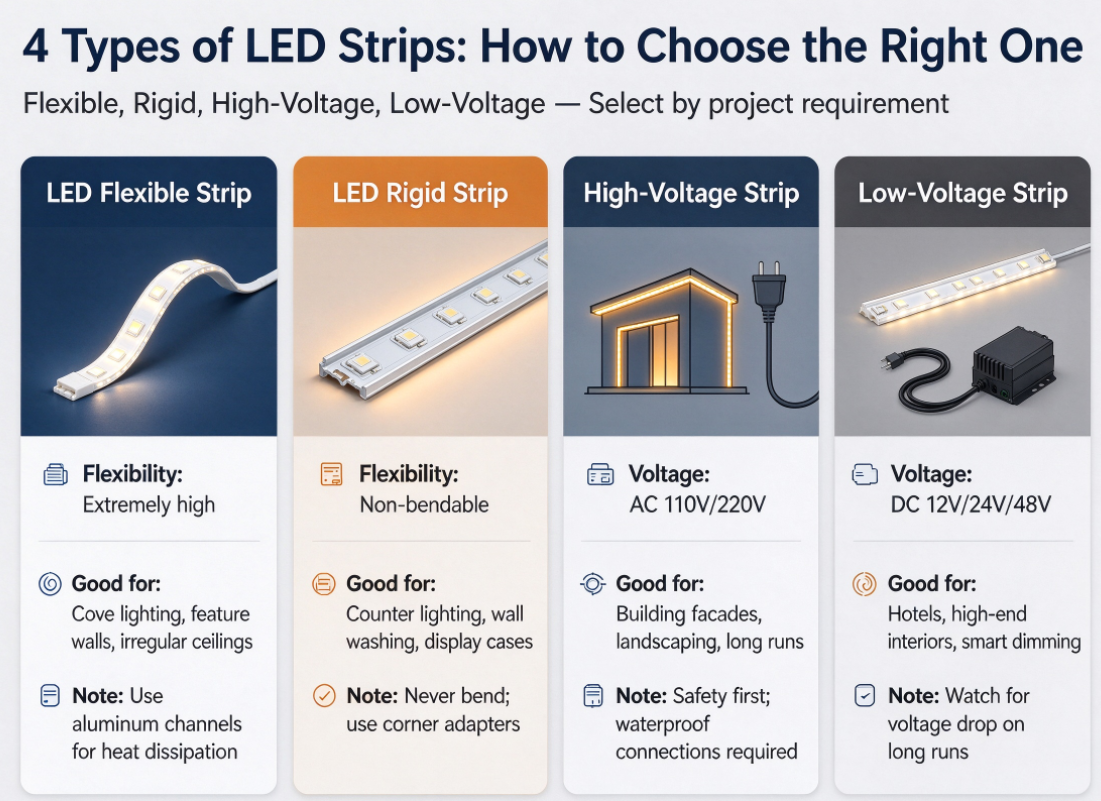
Types of LED strips come down to four main categories—flexible, rigid, high-voltage, and low-voltage—and picking the wrong one can delay your project and trigger costly rework. Whether it’s a home renovation, a shop fit-out, or a commercial lighting job, most people get a headache the moment they start choosing. Having worked in this industry for 20 years, I hear the same questions from procurement professionals: flexible strips that bend freely, or rigid bars for straighter light? High-voltage for convenience, or low-voltage for stability? This guide breaks down the differences, pros and cons, ideal applications, and installation methods for all four—so you can choose confidently.
I. LED Flexible Strip Lights: The “Versatile Performer” for All-Scenario Decoration
What are LED flexible strip lights? They utilize a flexible printed circuit (FPC) board. Because the circuit board is resistant to bending and twisting and is extremely thin (usually just 2mm)—allowing it to curve and flex like a ribbon—it is known as a flexible LED strip.
Key Advantages:
Excellent Flexibility: They can be coiled or bent to a certain degree; strips with special circuit designs (such as S-shaped strips) can even be twisted 360 degrees without damaging the circuitry.
Precise Cutting: They can typically be cut at intervals of 25mm–100mm to suit specific needs, making them a perfect fit for various non-standard dimensions.
Soft Lighting Effect: Especially when paired with 2oz–3oz rolled-annealed copper PCBs, the strips generate minimal heat during operation and offer highly consistent color uniformity (SDCM).
Price: The vast majority of linear lighting strips on the market today are flexible LED strips. They are more affordable than high-voltage strips and offer greater installation freedom than rigid strips, making them the top choice for cost-effectiveness.
Application Effects and Scenarios: Commonly used for cove lighting, interior feature walls, irregular ceiling designs, and under-shelf lighting in furniture. They create a premium “see the light, not the source” aesthetic.
Installation and Usage Notes: Do not pull or tug forcefully during installation. Since the FPC circuitry is delicate, excessive force can break internal conductors, resulting in “dead” LEDs. Using aluminum mounting channels for heat dissipation is recommended to extend lifespan.
II. LED Rigid Strip Lights (Aluminum Light Bars): The “Lighting Benchmark” for Wall Washing and Commercial Displays
What are LED rigid strip lights? They utilize a rigid PCB (such as an aluminum-based board or fiberglass board) as the substrate. Unlike flexible LED strips, they cannot be bent and must be installed in straight lines; they typically come in lengths of 0.5 meters or 1 meter per unit. Key Advantages:
Exceptional Straightness: The emitted light forms a perfectly straight line, avoiding the slight waviness that can occur with flexible LED strips when installed over long distances without continuous fixing.
Superior Heat Dissipation: Mounted directly onto an aluminum substrate, the material offers excellent thermal conductivity, allowing for higher power operation.
Durability: Robust construction ensures resistance to damage, even in demanding environments like commercial trade shows.
Price: More cost-effective than flexible LED strips or high-voltage strips, though with more limited application scenarios.
Visual Effects and Applications: Primarily used for counter lighting, jewelry display cases, wall-washing, and advertising light boxes. It delivers uniform illumination with a crisp, clean linear aesthetic.
Installation and Usage Precautions: Rigid LED strips must never be bent. Physical connections at corners require the use of adapters or corner connector cables.
III. High-Voltage LED Strips (AC Strips): The “Long-Distance Champions” of Outdoor Lighting
What are high-voltage LED strips? These strips (typically operating on AC 110V or 220V) connect directly to the mains power supply via a standard plug, eliminating the need for bulky switching power supplies.
Key Advantages:
Ultra-long cascading capability: A single power feed can drive lengths of 50–100 meters without voltage drop issues—a feat unmatched by low-voltage strips.
Ease of installation: They light up immediately upon plugging in, saving the hassle and cost associated with installing multiple transformers.
Applications and Visual Effects: Widely used for illuminating building facades, outlining architectural contours, landscaping, and large-scale outdoor decorations. They create a grand, imposing visual impact with excellent continuity.
Price: They are more expensive than other types of LED strips; however, extremely cheap high-voltage strips carry a risk of electrical leakage.
When installing and using them, remember one rule: Safety First!
Since they operate directly on high-voltage (220V) mains power, proper insulation is critical. Cutting is usually restricted to 1-meter intervals; unlike low-voltage strips, they cannot be cut to arbitrary lengths, making them somewhat less flexible. Connections must be made using compatible waterproof plugs; twisting exposed copper wires together to power the unit is strictly prohibited and extremely dangerous.
Furthermore, safety regulations generally prohibit installing high-voltage strips indoors at heights lower than 4 meters from the ground—such as on lower wall sections, furniture surfaces, or areas accessible to children—primarily to prevent the risk of accidental electric shock or leakage.
IV. Low-Voltage LED Strips (DC Strips): The “Safe Choice” for Most High-End Lighting Designs
Low-voltage LED strips are straightforward to understand; unlike the common “high-voltage strips” found in many homes, they operate on safer low voltages—typically DC 12V, 24V, or 48V. Since they cannot connect directly to standard household 220V outlets, they require a “transformer” (also known as a constant-voltage power supply) to convert high-voltage mains power into the appropriate low voltage.
Whether for residential renovations, commercial spaces, or professional lighting design, low-voltage LED strips have become a core choice for mid-to-high-end lighting solutions whenever there are specific requirements for light quality, safety, and control capabilities. Although installation involves an extra step—connecting the power supply—the trade-off yields superior safety, more flexible dimming and color-tuning effects, and a longer lifespan.
Key Advantages:
Safety: Operates below the human safety voltage threshold, posing no risk of electric shock even in areas accessible to touch.
Flicker-Free & Eye-Friendly: When paired with a high-quality driver, it delivers flicker-free illumination (no screen distortion when filmed with a smartphone) and stable light quality; it supports PWM or 0-10V dimming.
Long Lifespan: Stable voltage and PCB-based heat dissipation ensure minimal light degradation over time.
Applications & Scenarios: A standard feature in five-star hotels, private residences with “lamp-free” (ambient/indirect) lighting designs, and high-end showrooms. It creates rich layers of light and shadow and enables smooth, seamless dimming when integrated with smart control systems.
Installation & Usage Notes: Voltage drop is a critical factor. Generally, single-end power feeding is recommended for lengths up to 5 meters. For long-distance installations, using 24V strips paired with 2oz–3oz rolled-copper PCBs is recommended to minimize brightness differences between the start and end of the strip.
7
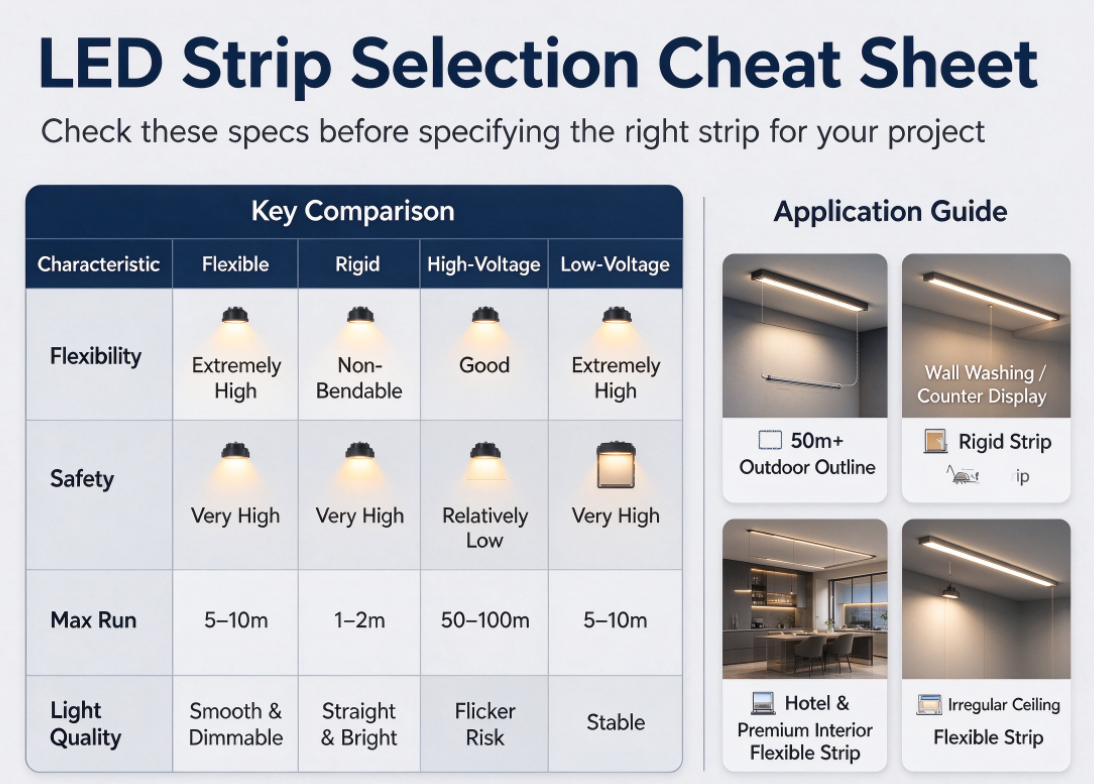
Quick-Reference Summary: Choose the Right LED Strip in One Minute
| Characteristic | LED Flexible Strip | LED Rigid Strip | High Voltage Strip | Low Voltage Strip |
|---|---|---|---|---|
| Flexibility | Extremely high, bendable | Non-bendable | Good (with sleeve) | Extremely high |
| Safety | Very High (24V) | Very High (24V) | Relatively Low (220V) | Very High (24V/48V) |
| Max Run Length | 5-10m | 1-2m | 50-100m | 5-10m |
| Light Quality | Smooth & dimmable | Straight, high brightness | Risk of flicker | Stable |
| Recommended Keywords | Flexible LED Strip | Aluminum PCB Rigid Bar | AC High Voltage LED Strip | DC Low Voltage LED Strip |
In the 2026 lighting project market, there is no such thing as a universally “good” LED strip—only the “right fit” for a specific application.
For outdoor outline lighting spanning over 50 meters, high-voltage strips offer superior efficiency; conversely, for the refined interior lighting environments of five-star hotels, low-voltage (24V) flexible strips paired with 2oz rolled-copper PCBs are the hallmark of quality.
Mingxue Optoelectronics operates a 24,000-square-meter production facility and has dedicated 20 years to the R&D of mid-to-high-end LED strips. We are committed to utilizing fully automated SMT processes and rigorous 8D quality control across our entire product line. Quality LED strips—crafted by Mingxue.


