
 ZH
 EN
 JA


LED Strip Without Aluminum Profile: When Can You Skip the Channel?
When designing whole-house “no-main-light” schemes, commercial linear lighting, or ambient ceilings, COB LED strips and dual-color flexible strips are usually paired with aluminum profiles and PC diffusers to tame glare and shed heat. But many designers ask the obvious question: are there cases where you can mount the strip directly and skip the channel? LED strip without aluminum profile installation is viable—but only in specific layouts. Here, Mingxue Lighting breaks down when a profile-free setup works, where it fails, and how to weigh the trade-offs before you specify.
1. Conditions for Using LED Strips Without Aluminum Profiles
In projects where there are no concerns regarding direct or indirect glare, and no specific requirements for aesthetics, heat dissipation, or optimized light output, low-voltage ambient LED strips or simple decorative light bars can be installed directly using 3M double-sided adhesive. Eliminating the need for aluminum profiles and diffuser covers simplifies the installation process. The most suitable scenarios for an aluminum-profile-free design are those where the LED light beam is directed upward toward the ceiling rather than downward toward the viewer’s eyes. Typical applications include cove lighting, linear lights concealed within ceiling recesses or behind beams, and decorative strips hidden within structural trusses. This type of concealed lighting layout offers three key advantages:
1.1 Absence of direct glare:
Since the light is projected upward, the light source remains entirely outside the viewer’s line of sight, preventing the harsh, piercing glare often associated with exposed LED points.
1.2 Absence of indirect glare:
When light is cast onto a ceiling finished with matte latex paint, it does not create the distracting reflections or “hot spots” that might occur on polished stone surfaces or glossy floor tiles.
1.3 Visual subtlety and aesthetic appeal:
Because the flexible light strips are tucked away behind architectural elements, the LED strips themselves remain hidden from direct view, preserving the clean, minimalist aesthetic of the space’s lighting design.
2. Key Drawbacks of Aluminum Profile Channels for Linear Lighting
While aluminum channels can enhance the light quality of LED strips used in engineering projects and indoor linear lighting, they also have distinct limitations that must be carefully weighed during the lighting design phase:
2.1 Increased Overall Project Costs:
Not only do the aluminum profiles and diffusion covers raise material procurement costs, but labor expenses for slotting, mounting, and cutting also rise in tandem; this can significantly inflate budgets for small-scale residential renovations or simple decorative lighting projects. Furthermore, PC diffusion covers typically have a light transmission rate of only 90%—resulting in a 10% loss of brightness compared to bare LED strips—so maintaining the same illuminance level requires higher-wattage strips, thereby increasing both initial procurement costs and long-term electricity expenses.
2.2 Lack of Flexibility and Limited Application Scenarios:
The rigid nature of aluminum rails prevents them from bending; consequently, they are unsuitable for projects requiring curved walls or arched ceilings where flexible neon-style LED strips might be used. Additionally, cutting aluminum channels on-site requires a hacksaw—a time-consuming and labor-intensive process—which drastically reduces installation efficiency compared to flexible LED strips that can be easily cut to length at any point.
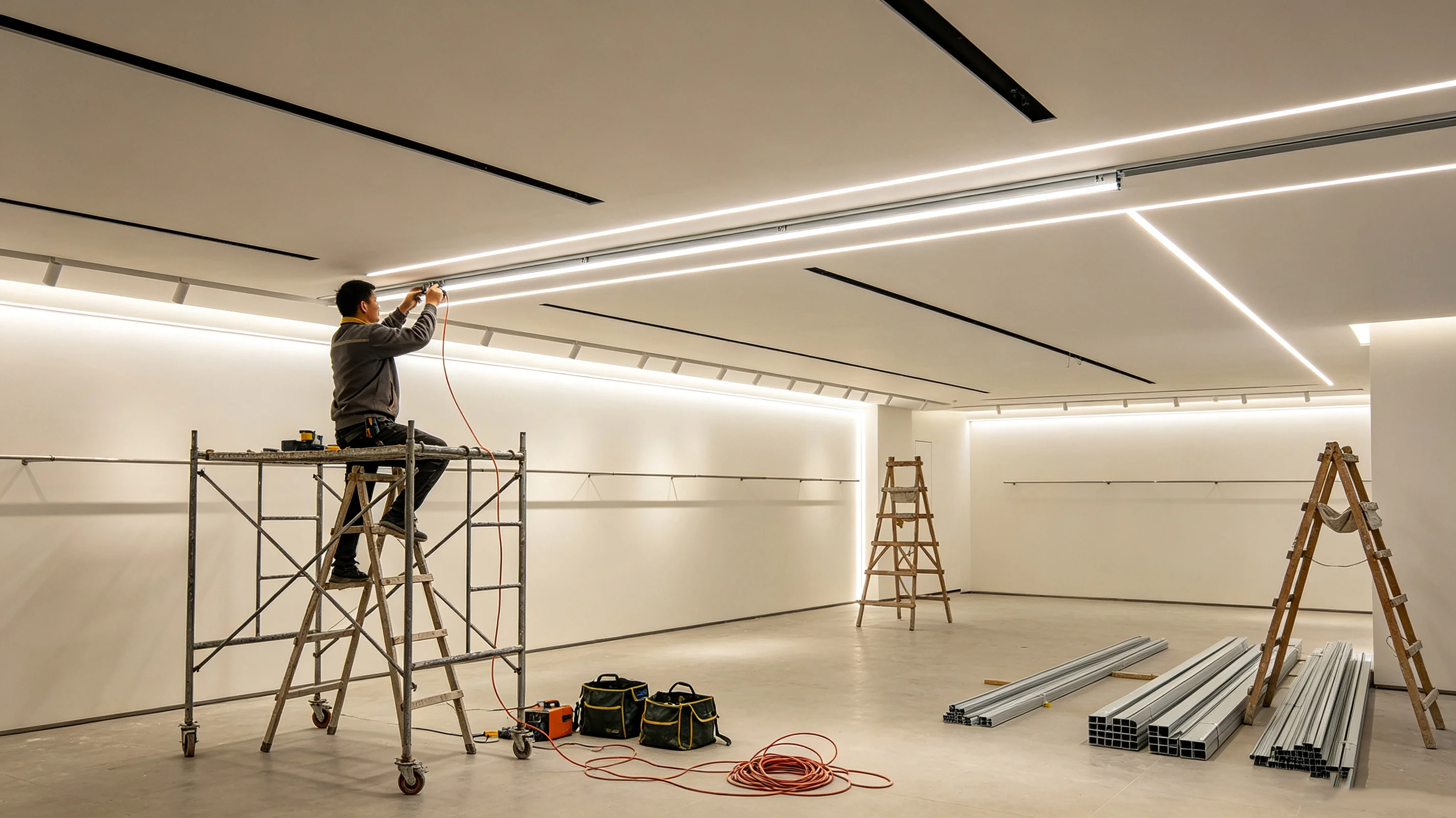
3. Comparison Table: Bare LED Strips (without aluminum channels) vs. Complete Linear Lighting Systems (with aluminum profiles)
| Comparison Dimension | Bare Flexible LED Strip (No Aluminum Channel) | Aluminum Profile + Diffuser Linear Light | Suitable Lighting Scenarios |
|---|---|---|---|
| Glare Control | Glare-free when recessed upward; glaring if mounted downward bare | Suppress direct / indirect glare at all angles | Living rooms, studies, showcase direct viewing lighting |
| Shape Adaptability | Freely bendable, fits curved ceilings | Rigid & non-bendable, straight installation only | Straight ceilings, building outline illumination |
| Brightness Loss | No brightness attenuation, full luminous efficiency | 10% brightness loss via diffuser | High-brightness building lighting projects |
| Project Cost | Lower material & labor cost | Higher material + installation cost | High-end villas, commercial standard lighting projects |
| Heat Dissipation | Poor heat dissipation for bare mounting, prone to lumen depreciation over time | Heat conduction via aluminum profile to extend strip lifespan | All-day long-hour office lighting |
4. Q&A Session
Q1: For a ceiling cove light designed to wash the ceiling with dual-color-temperature ambient light, will mounting the strip directly (without an aluminum profile) cause eye strain?
A: No. The light is directed upward onto a matte ceiling surface, keeping the light source out of the direct line of sight and eliminating direct glare. The matte finish prevents indirect glare from reflections, making this a suitable, cost-effective solution for simple home lighting designs that eliminates the need for aluminum profiles.
Q2: Why are aluminum profile channels not recommended for installing linear lights on curved walls?
A: Rigid aluminum profiles cannot be bent. For curved surfaces, it is best to mount flexible COB LED strips directly. Forcing the use of segmented aluminum channels would break the continuity of the light, resulting in a poor aesthetic and complicated installation.
Q3: Can aluminum channels be omitted for downward-facing display light strips in commercial storefront windows?
A: It is not recommended. Mounting strips directly without channels exposes the individual LED dots, creating intense direct glare. Furthermore, since window displays often feature glossy items, indirect glare from reflections is highly likely; using aluminum channels with diffusion covers is essential to ensure healthy, comfortable lighting.
Q4: Will LED strips mounted directly (without aluminum channels) experience lumen depreciation if left on for long periods?
A: Yes. Without the heat conduction and dissipation provided by aluminum profiles, heat accumulates within enclosed ceiling coves. Continuous operation of high-CRI strips in such conditions accelerates lumen depreciation; therefore, aluminum channels should be prioritized for scenarios requiring long-duration lighting, such as offices and retail stores.
Q5: For home renovation projects with limited budgets, in which lighting areas can aluminum profiles be omitted to save costs?
A: Aluminum profiles can be eliminated in favor of direct mounting for hidden linear lighting that faces away from the viewer’s line of sight—such as upward-facing ceiling cove lights, decorative strips concealed in ceiling beams, and ambient lights hidden within ceiling trusses.
When planning “ceiling-light-free” (recessed/indirect) lighting schemes for residential or commercial spaces, interior designers and contractors often struggle with whether or not to pair LED strips with aluminum profiles. Choosing the wrong approach can lead to issues like glare (causing eye strain), rapid light degradation, or unnecessary budget overruns.
With 21 years of deep expertise in LED linear lighting, Mingxue Optoelectronics operates a 24,000-square-meter production facility. We supply a comprehensive range of flexible LED strips, various aluminum profile channels, and optical diffusers—offering a one-stop solution for diverse lighting design requirements. For concealed ceiling-washing or hidden beam lighting, we provide high-adhesion COB LED strips and dual-color-temperature ambient strips that can be mounted directly, saving both time and money. For direct-view applications—such as in living rooms, retail displays, or office spaces—we offer integrated aluminum-profile systems that effectively control glare, enhance heat dissipation, and extend the lifespan of the LED strips.
We provide free product selection guidance based on your lighting design blueprints, helping you choose between simple, profile-free LED strips and complete aluminum-profile linear lighting systems. We also offer samples so you can compare light output and final installation effects. Whether you are sourcing LED strips for residential projects, commercial showrooms, or custom-shaped flexible neon lighting, Mingxue Optoelectronics ensures a stable supply. We provide the necessary aluminum accessories to help you strike the perfect balance between lighting performance and project costs, ensuring you avoid common pitfalls in lighting design and product selection.
Published by Mingxue Lighting | Founded 2005 | Shenzhen R&D Center + Foshan Manufacturing Base | 24,000 sqm | ISO 9001 Certified


