
 ZH
 EN
 JA


LED Strip Lifespan: LM-80, TM-21 & How to Extend It
LED strip lifespan is one of the most misunderstood specs in lighting procurement. Buyers often ask “how long does it last?” expecting a single expiration date—but an LED strip doesn’t spoil overnight. Its life is defined by gradual lumen depreciation and color shift, shaped by materials, thermal design, and driving method. With 21 years in the LED industry—from DIP LEDs to modern flexible strips—we break down what lifespan really means, why the LM-80 report is the global “passport” for engineering projects, and the invisible factors that decide whether your strip completes a true 50,000-hour run.
I. Does an LED reach the end of its life by “going out” or “changing color”?
Many people assume that an LED strip reaches the end of its lifespan only when it stops working entirely. However, from a professional engineering perspective, two scenarios occur when the rated lifespan is reached: “hard failure” (systemic damage), where hardware components fail after prolonged use; and “soft failure” (lumen depreciation or color shift). As the name implies, soft failure occurs when usage exceeds the LED chip’s rated life, resulting in gradual light output decay and a shift in color temperature.
1.1 Industry-recognized end-of-life criteria
LED strips are electronic products subject to the typical failure modes and replacement cycles of such devices. As semiconductor components, LEDs experience a slow decline in brightness over time. Lifespan is defined as the time it takes for the strip’s brightness to drop to 80% of its initial value. With 21 years of manufacturing experience, we recommend strictly adhering to the LM80 standard for applications such as commercial properties and five-star hotels; falling below this threshold significantly compromises the intended lighting atmosphere of the space.
1.2 Chromaticity shift: The overlooked “visual lifespan”
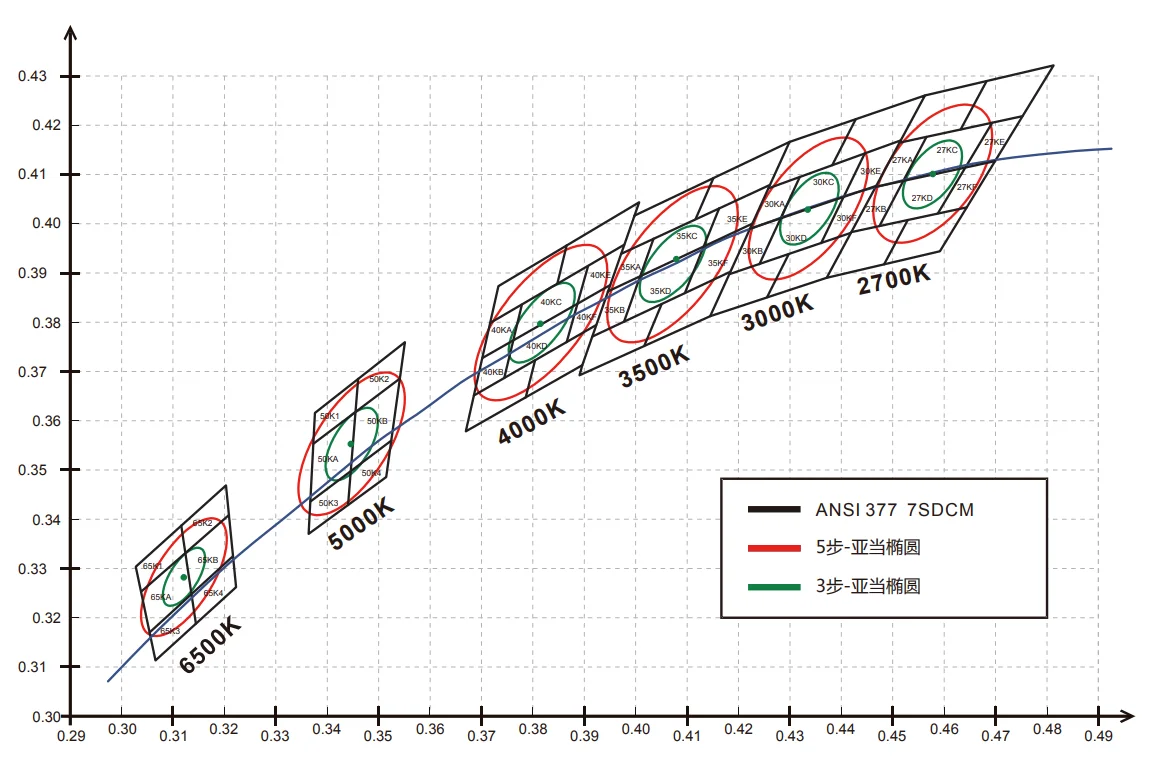
Consistency in color temperature is just as important as brightness. Many low-quality strips use substandard encapsulation materials, causing the light to shift from a 3000K warm white to a greenish or purplish hue after just 2,000 hours of use. High-standard strips must ensure that color consistency—measured by MacAdam ellipses (SDCM)—remains within a 3-step or even 2-step range throughout their entire lifespan, preventing permanent color discrepancies or premature component failure.
II. What is an LM-80 Report, and Why is it a “Passport” for Global Engineering Projects?
In international trade and large-scale municipal tenders, any claim regarding product lifespan is meaningless without supporting LM-80 data.
2.1 What is the LM-80 Test?
LM-80 is a testing standard for LED lumen maintenance established by the Illuminating Engineering Society (IES) of North America. It requires LED packages to be continuously illuminated at specific temperatures (typically 55°C, 85°C, and 105°C) for a minimum of 6,000 to 10,000 hours. Throughout the test, the LEDs must not fail or sustain damage, and lumen maintenance must remain above 80% of the initial output; these are the key benchmarks of the LM-80 standard.
2.2 TM-21 Projection: The Authority of Mathematical Modeling
When comparing the lifespans of LED strips, the linear lighting industry generally considers a product capable of exceeding 50,000 hours of operation to be of high quality (for instance, standard LED strips from Mingxue Optoelectronics boast a 50,000-hour lifespan). This figure is scientifically projected using the TM-21 algorithm based on empirical LM-80 test data. At Mingxue Optoelectronics, our expert R&D team—comprising over 20 specialists—conducts thermal simulation analyses of chip junction temperature distribution during the early stages of product development. This ensures that every product launched to the market is backed by comprehensive laboratory data, rather than unsubstantiated promises.
III. The “Invisible Killers” Affecting Lifespan: A Manufacturing Process Breakdown
As a large-scale LED strip manufacturer with a 24,000-square-meter production facility, we have observed on the production line that the key factor determining whether an LED strip can complete a “50,000-hour marathon” often lies in details invisible to the naked eye.
3.1 Heat-Dissipating Substrate: The “Lungs” of the LED Strip
Heat dissipation is a core performance indicator for LEDs.
Standard LED strips: Utilize 1-ounce (oz) or even thinner rolled-copper PCBs; when current flows through, significant heat is generated but difficult to dissipate.
Professional-grade design: We insist on using 2oz or 3oz double-sided rolled-copper substrates. The thick copper layer acts like a highway, rapidly conducting heat generated by the chip to the outside.
3.2 Encapsulation Materials and Gold Wire Bonding
Our R&D team is extremely rigorous regarding material selection. By using high-quality red copper lead frames and pure gold wire bonding (instead of cheap alloy wires), we effectively withstand stress caused by thermal expansion and contraction, preventing “dead lights” resulting from broken solder joints.
IV. Insights from 21 Years of Experience: How to Extend the Actual Lifespan of LED Strips?
As a veteran manufacturer in the LED strip industry, we have summarized three practical tips to significantly extend the effective service life of your LED strips:
4.1 Say No to “Naked” Strips—Embrace Aluminum Channels:
Pairing LED strips with dedicated aluminum profiles can improve heat dissipation efficiency by over 40%.
4.2 Match with High-Quality Constant-Voltage Power Supplies:
In the LED strip industry, I often emphasize a key point to clients: high-quality strips require high-quality power supplies—just as a fine horse deserves a fine saddle. Don’t underestimate this step; the current ripple from a low-quality power supply acts like a dull blade. It may not look harmful, but every pulse effectively “hammers” your LED chips. This repeated stress leads to premature lumen depreciation, causing the strips to lose brightness quickly. Therefore, when selecting a power supply, you must choose a branded driver that is a worthy match for your UL/CE-certified LED strips.
4.3 Ensure Sufficient Power Supply Headroom:
Many people try to save money by purchasing a power supply that barely meets the strip’s power requirements—a major mistake. I recommend choosing a driver with a power rating approximately 20% higher than the strip’s actual power consumption. This extra 20% margin allows both the power supply and the LED strip to operate within a “comfort zone”; it prevents the power supply from being overworked while ensuring stable operation for the strip, resulting in significantly better overall longevity and stability. It is a worthwhile investment by any calculation.
| Comparison Dimension | Professional Grade (Constant Current) | Engineering Grade (Constant Voltage) | Impact on Project Lifespan |
|---|---|---|---|
| Drive Principle | Constant current output; LED current remains stable regardless of voltage fluctuations | Constant voltage output; current changes with voltage and temperature | Professional grade provides more stable current, reducing lumen degradation |
| Light Attenuation Performance | Low light attenuation; typical L70 lifespan up to 50,000 hours | Higher light attenuation; faster decline in long-term use | Lower attenuation helps maintain consistent brightness over the project lifecycle |
| Over-Temperature Protection | Built-in over-temperature protection; automatically reduces current or shuts down when overheated | Basic temperature protection only; may lack active over-temperature control | Professional-grade protection effectively reduces premature failure from overheating |
| Dimming Compatibility | Compatible with leading-edge, trailing-edge, 0–10V, DALI, DMX and other protocols | Mainly compatible with TRIAC and simple PWM dimming | Professional-grade dimming is more stable, reducing flicker and driver damage |
| Typical Applications | High-end hotels, luxury shops, museums, medical aesthetic spaces, high-end offices | Commercial stores, ordinary offices, residential common areas, basic landscape lighting | Professional grade is more suitable for long-term high-standard engineering projects |
The lifespan of an LED strip is the ultimate test of a company’s reputation—a true marathon of reliability. At our 24,000-square-meter production facility, we strive daily to achieve higher luminous efficacy and greater longevity. Our 21 years of industry experience have taught us that effective marketing isn’t about dazzling specifications; it’s about ensuring your project shines just as brilliantly five or ten years down the line.
We offer more than just LED strips; we provide a comprehensive, field-proven selection of reliable products. Furthermore, we share insights gained from our own past lighting projects to help elevate your installation to the next level.


